Author: Darryl M. Perrilloux, CSCS | Executive Director, Perrilloux Performance
Category: Applied Healthspan / Translational Physiology
Reading Time: 6 Minutes
I. The Illusion of the "Clean" Executive Physical
Every year, thousands of driven executives, entrepreneurs, and athletes sit down with their corporate physician, look over their annual lab work, and breathe a sigh of relief.
Fasting blood sugar: 92 mg/dL (Normal).
Hemoglobin A1c: 5.3% (Normal).
Their doctor slaps them on the back and says, "Everything looks great. Keep doing what you’re doing."
Yet beneath the surface, these same high-performers are struggling with mid-afternoon cognitive brain fog, stubborn abdominal fat accumulation, and lagging recovery.
Here is the inconvenient truth of modern corporate medicine: Fasting blood sugar and HbA1c are lagging indicators. Relying on them to assess your metabolic health is like waiting for smoke to billow from your car engine before checking the oil.
By the time your blood sugar moves into the "pre-diabetic" range on a standard annual test, the underlying engine has often been failing silently for over a decade.
To fix it, we have to look at the primary engine of human metabolism: your skeletal muscle.
II. Your Muscle is a 40-Ton Cargo Warehouse
When you eat a meal containing carbohydrates, your digestive tract converts that food into glucose (sugar) in your bloodstream.
Your bloodstream is a delicate delivery highway. At any given moment, your entire circulatory system can safely hold only about one single teaspoon of sugar (about 4 grams). Anything more is toxic to your blood vessels and brain.
So where does all that sugar go after a meal?
Over 80% of it must be cleared into your skeletal muscle tissue.
Your muscles are not just for lifting weights or looking athletic—they are the master cargo warehouse and metabolic sponge of the human body.
III. The Breakthrough: Why the Delivery Lock Jams
For thirty years, the medical establishment believed that "insulin resistance" was caused by eating too much sugar, which wore out the cell's receptors.
Dr. Gerald Shulman and his research team at Yale School of Medicine completely overturned that myth.
Using advanced magnetic resonance spectroscopy, Dr. Shulman discovered what actually happens inside human muscle tissue: The problem doesn't start with sugar. It starts with microscopic fat sludge.
Think of it like this:
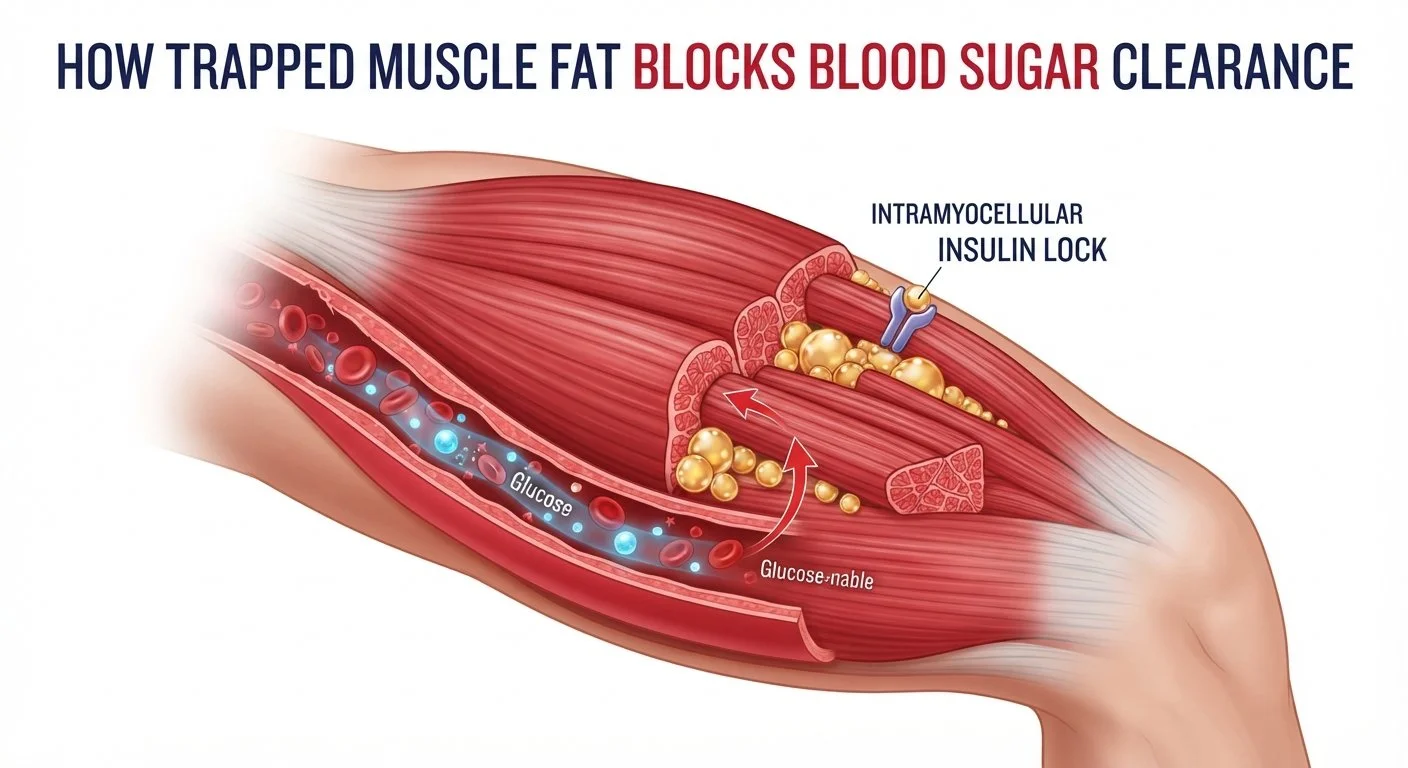
Insulin is the Delivery Key: When blood sugar rises, your pancreas releases insulin. Insulin travels to your muscle cell and inserts into a molecular keyhole, signaling the warehouse doors (called GLUT4 gates) to slide open and let the sugar in.
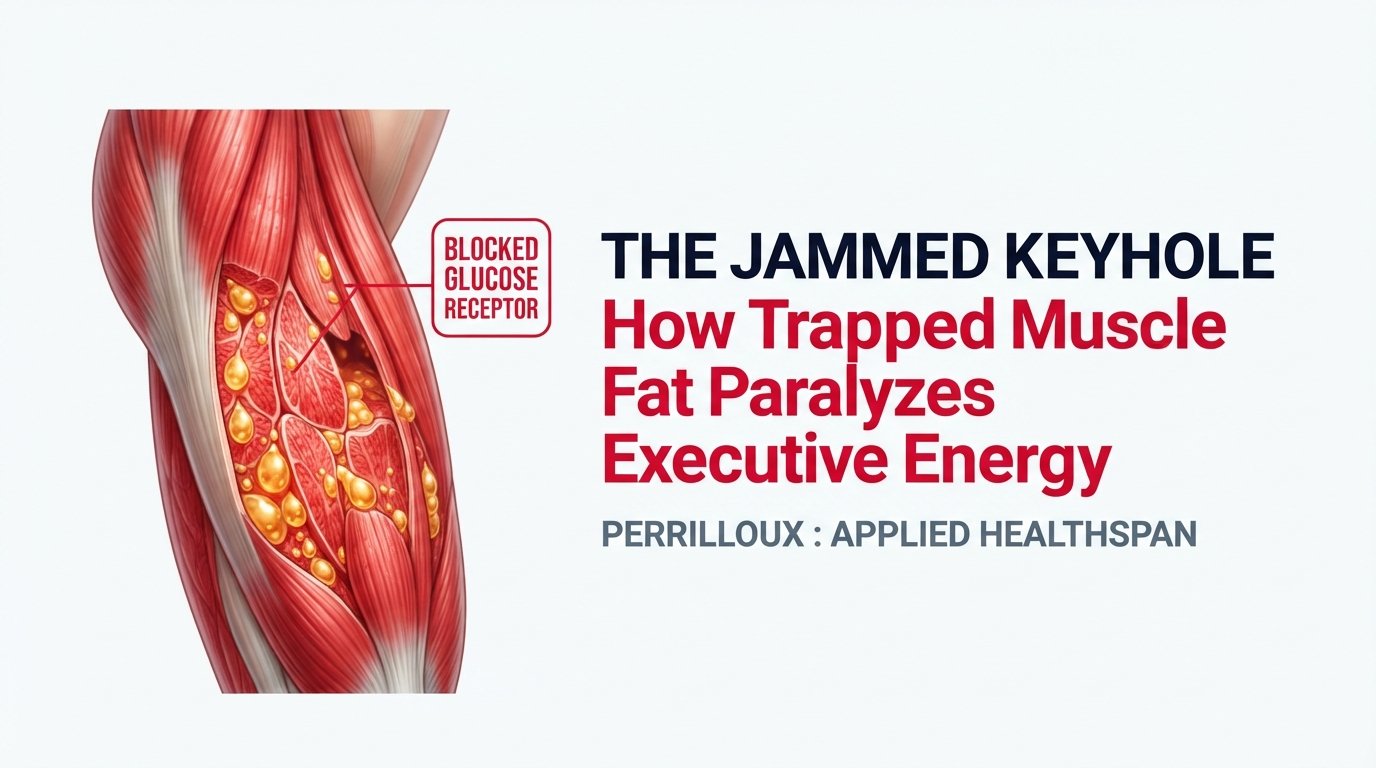
The Fat Sludge Accumulates: When you consume more energy than your body burns—combined with prolonged sitting and lack of specific muscle recruitment—microscopic droplets of unburned fat (called diacylglycerols, or DAGs) back up inside your muscle fibers.
The Lock Jams from the Inside: This fat sludge triggers an internal alarm switch inside the cell. That switch glues the keyhole shut from the inside.
The Glucose Stays Trapped Outside: When insulin arrives with the key, the key won't turn. The warehouse doors stay locked. The sugar is rejected and left circulating in your bloodstream, forcing your pancreas to pump out 2x, 3x, or 5x more insulin just to force the doors open.
Your pancreas compensates by working overtime for 5, 10, or 15 years—keeping your fasting blood sugar looking "normal" on your annual lab tests—while your cells are suffocating in metabolic gridlock.
IV. The Two-Step Performance Architecture to Clear the Jam
You cannot fix a jammed keyhole by simply cutting carbs or taking a prescription pill. You have to physically clear the intracellular fat sludge out of the warehouse.
At Perrilloux Performance, we translate Dr. Shulman’s Yale research into a precise, two-vector operational protocol:

VECTOR 1: DRAIN THE SLUDGE (Zone 2 Mitochondrial Aerobic Base)
• What to do: 150–200 minutes per week of steady, low-intensity cardio (brisk incline walk, stationary cycling, or rowing) at a pace where you can still maintain a conversation.
• The Mechanism: Zone 2 forces your muscle mitochondria to burn pure fat for fuel, draining the intramuscular DAG sludge and un-jamming the insulin lock from the inside.
VECTOR 2: OPEN THE EMERGENCY SIDE DOORS (High-Tension Resistance Training)
• What to do: 3 to 4 days per week of targeted, multi-joint resistance training.
• The Mechanism: When muscle fibers contract against heavy resistance, they activate an emergency backup pathway (AMPK). This completely bypasses the jammed insulin keyhole and forces the warehouse doors open directly—pulling sugar out of your blood with zero insulin.
V. The Bottom Line for Executive Performance
True healthspan is not about waiting for a disease diagnosis; it is about engineering metabolic surplus.
When your skeletal muscle is clear of intracellular sludge, your body burns fat efficiently, your brain receives steady, crash-free energy throughout 10-hour working days, and your cardiovascular system is protected from systemic inflammation.
Stop relying on 20th-century lagging blood tests. Build the muscular architecture that protects your performance, your career, and your longevity.