Author: Darryl M. Perrilloux, CSCS | Executive Director, Perrilloux Performance
Category: Applied Healthspan / Translational Neurovascular Physiology
Reading Time: 6 Minutes
Translating Dr. Richard Isaacson’s Clinical Research on Capillary Perfusion, Glymphatic Flux, and Synaptic Stamina.
I. The 3-Pound Blind Spot on Your Annual Health Panel
If you look at the lab panels from your last corporate physical, you will find comprehensive diagnostic data on your heart (lipids, ECG), your liver (hepatic enzymes), your kidneys (eGFR), and your systemic blood markers (CBC).
Notice what is missing: your brain.
Standard medicine does not monitor cerebral health until an individual reaches their late 60s or 70s, struggling to recall basic names or navigate familiar streets. When a 45-year-old executive mentions 2:00 PM cognitive latency, sluggish decision-making speed, or persistent mental fatigue, the medical establishment dismisses it as ordinary corporate burnout: "Get eight hours of sleep, manage your stress, and drink more water."
Relying on overt memory loss to detect brain aging is like waiting for a rod to punch through your engine block before checking your oil pressure.
Cognitive decline is not a sudden geriatric event. It is a 25-year microvascular and metabolic degradation process. What executives write off as "brain fog" is frequently the earliest measurable symptom of microvascular constriction and impaired brain waste clearance.
II. The 400-Mile Micro-Cooling Network
Your brain makes up roughly 2% of your total body weight, yet it consumes more than 20% of your total oxygen, glucose, and cardiac output.
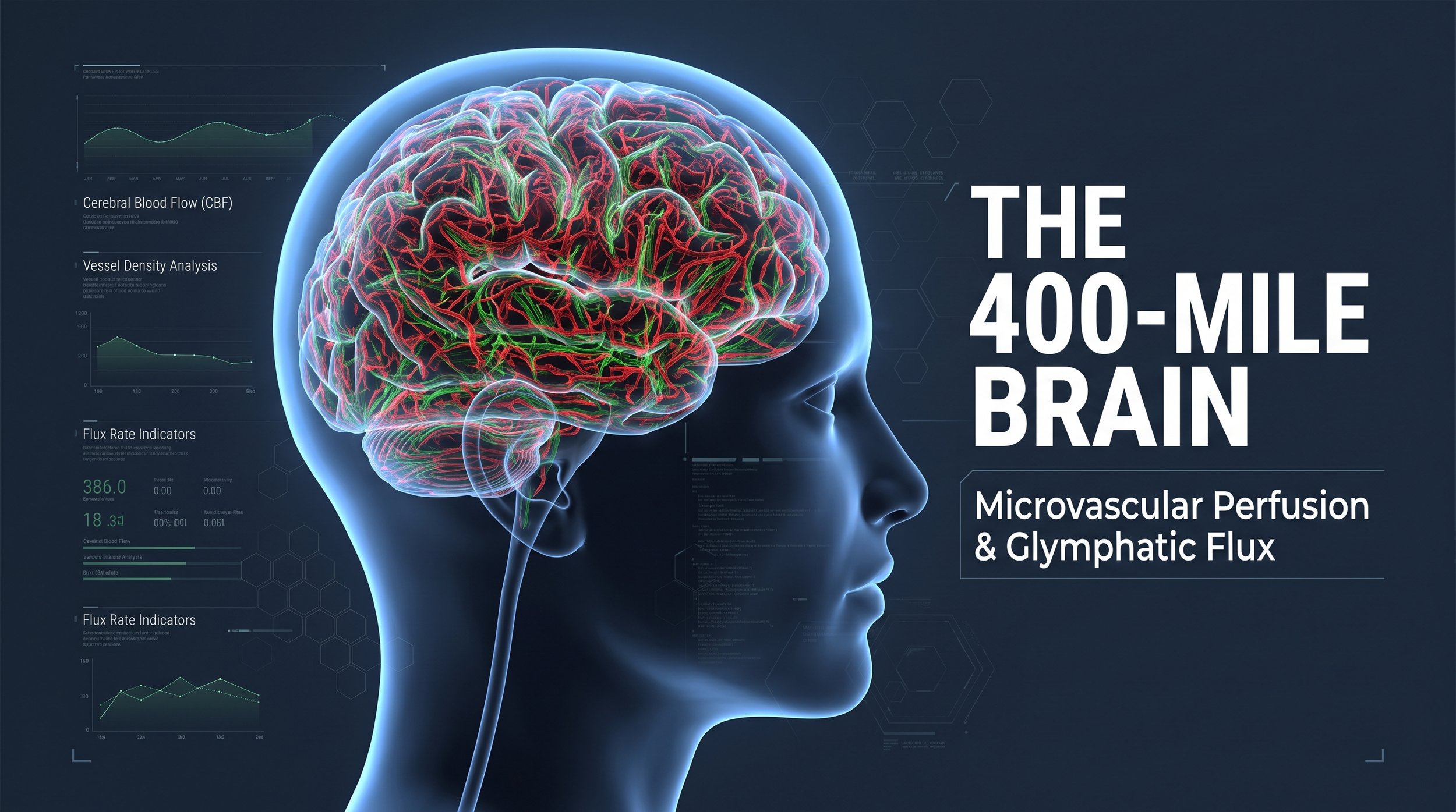
Every strategic decision, quarterly projection, and high-pressure negotiation runs across a dense biological superhighway: over 400 miles of microscopic capillaries threading through neural tissue.
Unlike skeletal muscle or adipose tissue, your brain possesses zero onboard energy storage. It cannot stockpile glycogen or store backup fuel. Every neuron relies on real-time, continuous blood flow through capillaries so narrow that red blood cells must travel in single file.
If those micro-vessels stiffen or narrow by even a fraction of a millimeter:
Oxygen delivery to the hippocampus drops.
Astrocytes struggle to transport glucose across the blood-brain barrier.
Metabolic exhaust accumulates directly in the synaptic gaps between neurons.
III. The Clinical Shift: Alzheimer’s Starts as a Vascular Problem
For decades, neurology viewed Alzheimer’s, vascular dementia, and cognitive decline strictly as unavoidable genetic conditions driven exclusively by amyloid plaque accumulation.
Dr. Richard Isaacson, preventive neurologist and founder of the Center for Brain Health, demonstrated that the underlying vulnerability begins in the vascular and metabolic systems decades before clinical memory impairment surfaces.
Your brain adapts for 10 to 20 years by running at reduced processing speeds—maintaining basic function while executive cognitive bandwidth quietly degrades.
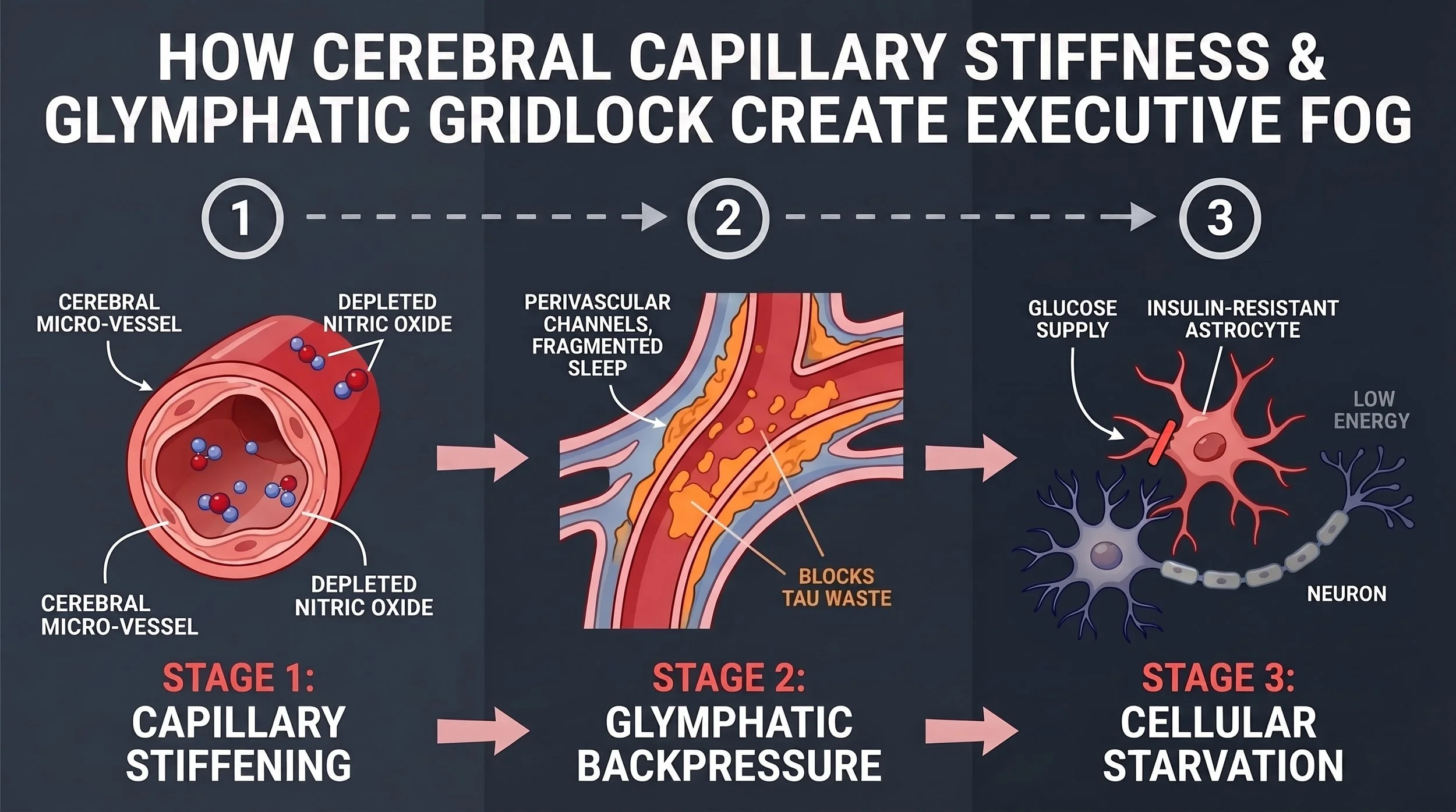
THE 3 STAGES OF EARLY NEUROVASCULAR BREAKDOWN
STAGE 1: CAPILLARY HYPOPERFUSION (The Microvascular Stiffening). Sedentary desk work and constant cortisol production deplete endothelial nitric oxide (eNOS). Capillaries lose elasticity, reducing cerebral blood volume and starving memory centers of oxygen.
STAGE 2: GLYMPHATIC BACKPRESSURE (The Nightly Cleaning Failure). The brain lacks a lymphatic system. It flushes neurotoxic tau and amyloid debris through perivascular "Glymphatic" channels that open strictly during deep Slow-Wave Sleep (SWS). Late-night dining and elevated glucose spike nighttime insulin, blunting SWS and trapping waste.
STAGE 3: CEREBRAL BIOENERGETIC STARVATION (Type 3 Diabetes). Chronic insulin spikes desensitize astrocytic glucose transporters. Even with high blood sugar, fuel cannot cross into neurons. The brain enters localized starvation, causing acute brain fog.
IV. The Perrilloux 2-Part Neurovascular Protocol
You cannot solve microvascular constriction with nootropics, caffeine, or smart drugs. You must physically rebuild capillary elasticity and clear perivascular drainage channels.
At Perrilloux Performance, we translate Dr. Isaacson’s neurovascular research into a structured, two-vector operational protocol:
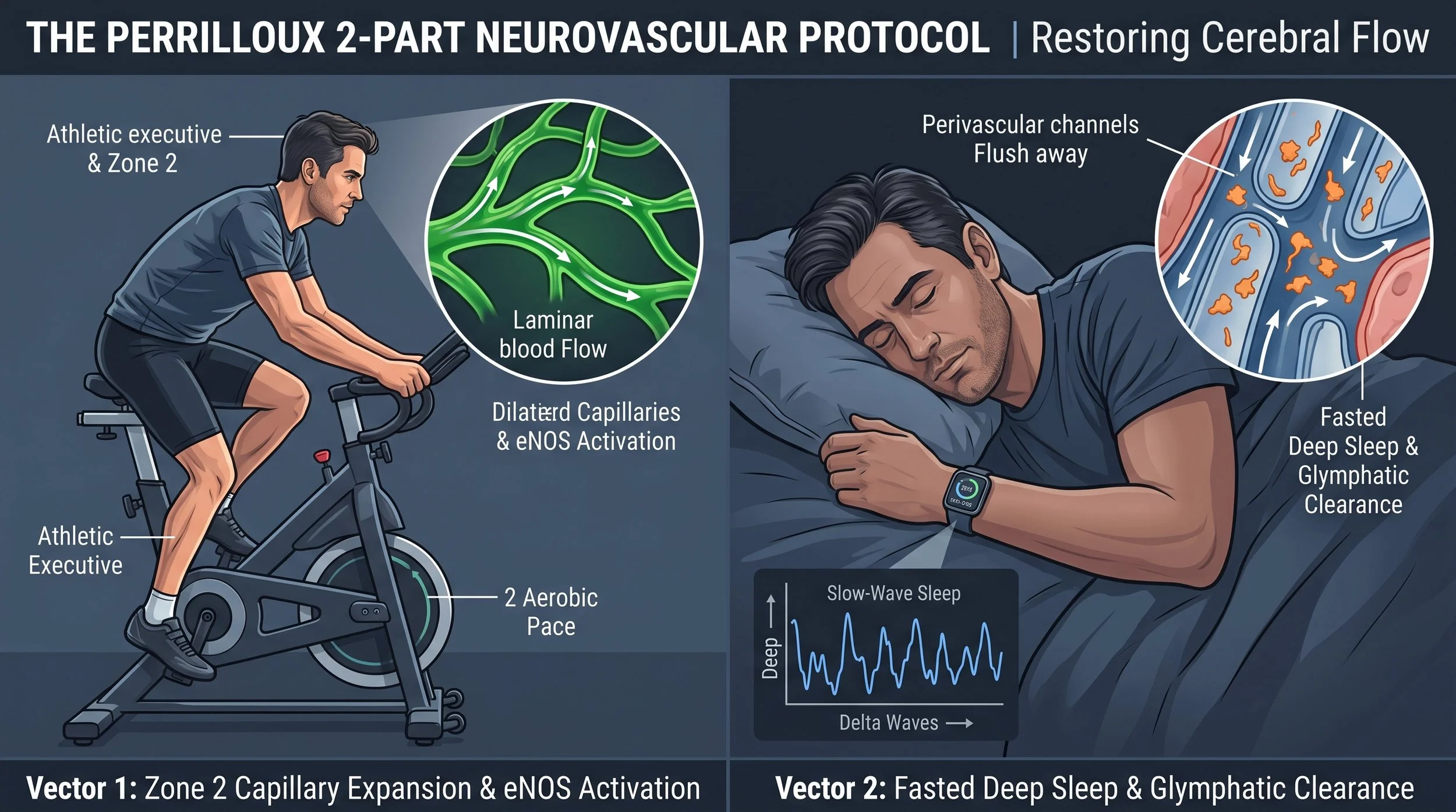
THE PERRILLOUX 2-PART PROTOCOL | Restoring Neurovascular Flow & Stamina
VECTOR 1: THE MICROVASCULAR SHEAR FLUSH (Zone 2 Capillary Dilation)
• What to do: 150–180 minutes per week of sustained Zone 2 aerobic output (65–75% HRmax).
• The Mechanism: Rhythmic, steady-state blood flow creates laminar shear stress against capillary walls, triggering endothelial nitric oxide synthase (eNOS) to dilate deep cerebral vessels.
VECTOR 2: THE NOCTURNAL GLYMPHATIC FLUSH (Fasted Deep-Sleep Architecture)
• What to do: Cease eating 3 hours prior to sleep + 3 days/week heavy resistance loading.
• The Mechanism: Eliminating nighttime glycemic excursions preserves delta-wave Slow-Wave Sleep, allowing astrocytic AQP4 channels to open and flush neurotoxic waste out of the brain. Heavy strength training restores insulin sensitivity, allowing fuel to cross into neurons.
V. The Bottom Line for Executive Performance
Cognitive processing speed, working memory, and sustained afternoon focus are not personality traits—they are engineered vascular outputs.
When your cerebral capillaries are elastic, your nocturnal drainage valves operate unimpeded, and your neurons receive steady metabolic fuel, executive brain fog disappears. You gain durable, crash-free focus across long operating days.
Do not wait for standard medicine to notice a memory problem in your 70s. Build the vascular architecture that protects your cognitive edge, your career, and your sovereign healthspan.
APPENDIX: THE CLINICAL EVIDENCE BASE
This article translates peer-reviewed clinical research and foundational neurovascular physiology into operational protocols.
The clinical proof-of-concept for targeted, multi-domain interventions is anchored in:
The Clinical Data: This prospective clinical trial demonstrated that individualized, patient-tailored lifestyle interventions addressing cardiovascular risks, targeted exercise regimens, metabolic biomarkers, and nutrition significantly improved cognitive performance (m-APCC score) and metabolic risk profiles in patients at risk for neurodegeneration.
Translational Architecture: Perrilloux Performance operationalizes these clinical findings by integrating established vascular shear-stress mechanics (eNOS upregulation) and sleep-dependent perivascular glymphatic flux into an actionable executive healthspan framework.