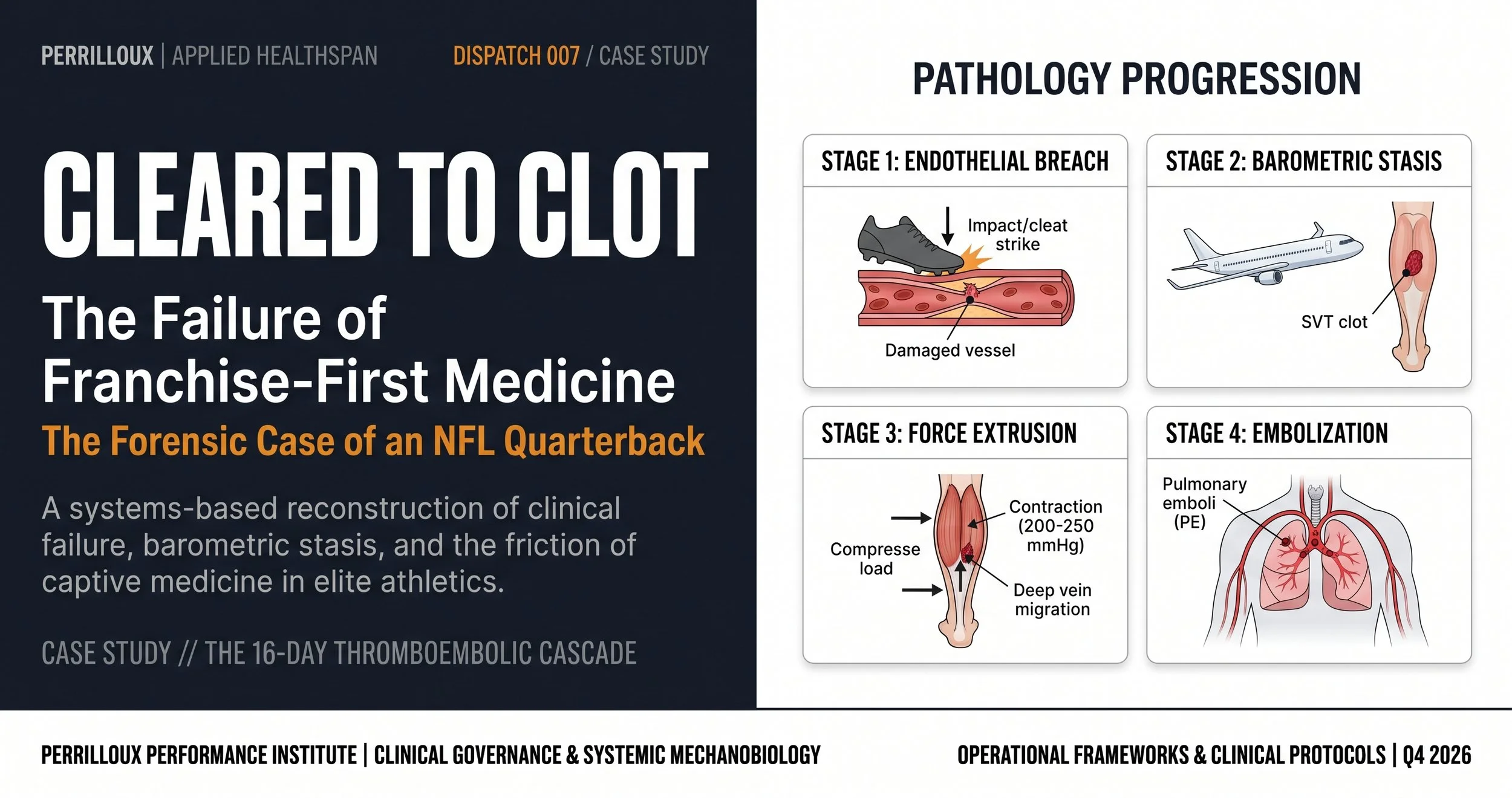
Cleared to Clot
The Jalen Hurts Vascular Crisis & The Failure of Franchise-First Medicine
Author: Darryl M. Perrilloux, CSCS | Executive Director, Perrilloux Performance
Clinical Pillar: Pillar I–V Integrated Systems Governance
Category: Systems Mechanobiology & Medical Governance
Time: Q4 2026
Translating: The Forensic Telemetry of the Jalen Hurts Vascular Crisis & The Structural Imperative of Independent Clinical Oversight
In high-performance professional sports and corporate environments, a fatal structural contradiction is evident: who signs the doctor's paycheck?
When a franchise quarterback earning $255M per year or a CEO at one of the world's largest corporations enters the medical room at an institution to be treated as a patient, each assumes that the medical team has one singular goal: to help preserve the patient's healthspan over time. That is an incorrect assumption in most legacy health care systems. Medical personnel are employees of the organization; therefore, their medical decision-making takes place within an ecosystem in which Sunday roster availability is the primary reward function.
The case of Philadelphia Eagles quarterback Jalen Hurts is a prime example of the risks of treating patients in such a medical environment. In addition to this, on October 20, 2026, league executives determined that no penalties would be assessed to the Philadelphia Eagles regarding Jalen Hurts’ DVT diagnosis (deep vein thrombosis) and secondary bilateral pulmonary embolism (blood clots in both lungs). More disturbingly, they declared that the medical staff’s clearance protocols had been “handled appropriately” [Yahoo Sports].
In terms of model design, this administrative clearance sets a precedent that such a catastrophic, multi-organ-system event is simply treated as a binary availability metric. The validation of this clearance process without prior history or longitudinal safety data demonstrates how the league’s centralized framework will introduce an extremely latent variable into future player-risk regression models — prioritizing current cross-sectional roster optimization for each team over tracking of an athlete’s biometric baselines for longevity and his/her own systemic physical compliance [Pro Football Rumors].
The Forensic Timeline: Separating Verified Fact from Media Noise
Social media and sports television have devolved into conflicting rumors, retracted sleep claims, and pundits complaining about ruined gambling parlays. At the Perrilloux Performance, we deal strictly in verified telemetry.
Below is the objective, primary-source reconstruction of the 16-day cascade:
| Date & Time | Operational Event | Clinical & Physiological Reality | Verified Primary Source |
|---|---|---|---|
| Sun, Oct. 4, 20261:00 PM ET | The Initial Trauma: Hurts is cleated in the left calf during Philadelphia’s 24–20 Week 4 loss to the Los Angeles Rams. | Direct blunt-force mechanical trauma damages the local venous endothelium in the posterior lower leg (Vector 1 of Virchow’s Triad), initiating localized inflammatory coagulation. | Philadelphia Eagles Official Statement (Oct. 15, 2026); CBS Sports |
| Thu, Oct. 8, 2026Post-Practice | The First Triage Node: Experiencing persistent calf soreness, Hurts visits the Eagles’ training room after practice to request treatment and reports the Oct. 4 cleat strike. | Hurts is listed on the Week 5 injury report with a calf injury, but no diagnostic ultrasound is reported prior to departure. He practices in full on Friday, Oct. 9. | Philadelphia Eagles Official Statement (Oct. 15, 2026); NFL Injury Report |
| Fri, Oct. 9, 2026Evening Transit | Transatlantic Flight #1: Hurts boards a ~7.5-hour team flight from Philadelphia to London, arriving late Friday night. | Prolonged seated venous stasis + cabin pressurization at 6,000–8,000 ft equivalent altitude (hypobaric hypoxia) accelerates thrombin generation in a traumatized vessel. | CBS Sports; The Guardian (Oct. 20, 2026) |
| Sat, Oct. 10 – Sun, Oct. 11Until 4:00 AM BST | The London Hospital Evaluation: Out of an “abundance of caution,” Hurts undergoes imaging in London, remaining at the hospital until 4:00 a.m. local time on Sunday morning. | Imaging reveals a left calf Superficial Vein Thrombosis (SVT). Team doctors and London specialists conclude “activity and mobility were important and that Jalen could safely play.” Systemic blood thinners (which mandate immediate contact disqualification) are not initiated. | Philadelphia Eagles Official Statement (Oct. 15, 2026); ESPN / NFL Network |
| Sun, Oct. 11, 20264:00 AM – 2:30 PM BST | The Sleep Deprivation Controversy: Initial NFL Network reports (Pelissero/Rapoport) state doctors told Hurts not to sleep as a precaution, leaving him awake for 36 hours. Agent Nicole Lynn later clarifies the team set up a stadium room where he got brief sleep after his 4:00 a.m. discharge. | Whether 0 hours or 3–4 hours of fragmented stadium sleep after a 4:00 a.m. hospital discharge, acute circadian disruption spikes sympathetic tone, blood pressure, and endothelial shear stress prior to kickoff. | NFL Network (Tom Pelissero); Agent Nicole Lynn Clarification via CBS Sports & Crossing Broad (Oct. 19, 2026) |
| Sun, Oct. 11, 20262:30 PM BST / 9:30 AM ET | The Kinetic Exposure: Hurts plays all 4 quarters against Jacksonville in London (21/40, 220 yds, 1 TD; season-low 2 rush attempts for 2 yds) in a 19–17 loss. | High-intensity collision football subjects an un-anticoagulated lower-extremity thrombus to extreme intramuscular calf pressure, catecholamine surges, and blunt trauma. | NFL Game Log; Philadelphia Eagles Official Statement (Oct. 15, 2026) |
| Sun, Oct. 11, 2026Night Transit | Transatlantic Flight #2: Hurts flies 7.5–8 hours back from London to Philadelphia with the team Sunday night. | A second long-haul hypobaric cabin exposure immediately following 60 minutes of NFL contact trauma compounds venous stasis and hypercoagulability. | CBS Sports Timeline (Oct. 20, 2026) |
| Wed, Oct. 14, 2026Afternoon & Night | The Clot Migration: Hurts practices in full Wednesday afternoon and tells reporters the London lead-up was “a very unique experience.” That night, a follow-up ultrasound reveals movement in the blood clot. | Migration of a superficial calf thrombus toward or into the deep venous system (via perforating veins or the saphenopopliteal junction) represents an acute embolic emergency. | Philadelphia Eagles Official Statement (Oct. 15, 2026); PhillyVoice |
| Thu, Oct. 15 – Sat, Oct. 17Week 6 Triage | Shutdown & IR Placement: Hurts is held out of Thu/Fri practice. On Oct. 15 (1:00 PM ET), the Eagles announce he is out for Week 6 due to a moving superficial clot. On Oct. 17, he is placed on Injured Reserve (IR). | While Hurts undergoes external specialist testing, NFL Network’s Michael Robinson mocks the “superficial” clot on TV, suggesting Hurts is quitting on a “lost season,” while Chris Simms complains about ruined betting parlays. | Philadelphia Eagles Official Statements (Oct. 15 & 17, 2026); Pro Football Talk |
| Mon, Oct. 19, 202610:15 AM ET | The Escalation Diagnosis: A joint statement from the Eagles and agent Nicole Lynn reveals evaluations by external “physician experts” found Deep Vein Thrombosis (DVT) and Bilateral Pulmonary Emboli. | Clots have established in the deep venous system and embolized through the right heart into both lungs. Hurts is placed on systemic anticoagulants (minimum 3+ months), ending his 2026 season. | Joint Statement: Philadelphia Eagles & Agent Nicole Lynn (Oct. 19, 2026); Associated Press |
| Tue, Oct. 20, 2026League Audit | Institutional Exoneration: League sources state the NFL will not punish the Eagles, concluding the clearance and lack of pre-game injury designation were “handled appropriately.” | Proof of Fiduciary Capture: The league’s regulatory apparatus validates a process that cleared a player who developed bilateral pulmonary emboli within the week. | The Athletic (Jonathan Jones, Oct. 20, 2026) |
The Mechanobiology of a Preventable Catastrophe: How a Calf Contusion Became Bilateral Pulmonary Emboli
To the average viewer — as well as the broadcast pundits who publicly ridiculed the diagnosis — a Superficial Vein Thrombosis (SVT) appears innocuous. To practitioners of conventional, sedentary medicine, an acute superficial clot on the lower leg is typically treated as a minor, self-limiting nuisance compared to its lethal cousin, Deep Vein Thrombosis (DVT).
However, in a high-performance athlete with transcontinental travel and collision kinetic forces impacting him over the course of just 16 days, such distinctions are illusory.
The human venous system is not comprised of independent tubes or pipes but rather represents a pressurized network of interconnected hydraulic conduits. The superficial veins of the lower extremity (the great and small saphenous vein systems), therefore, drain directly into the deep venous circulation (popliteal and femoral veins) by means of two main anatomical junctures: the saphenopopliteal junction located posterior to the knee and hundreds of transverse perforator veins that pass directly through the deep fascia of the calf.
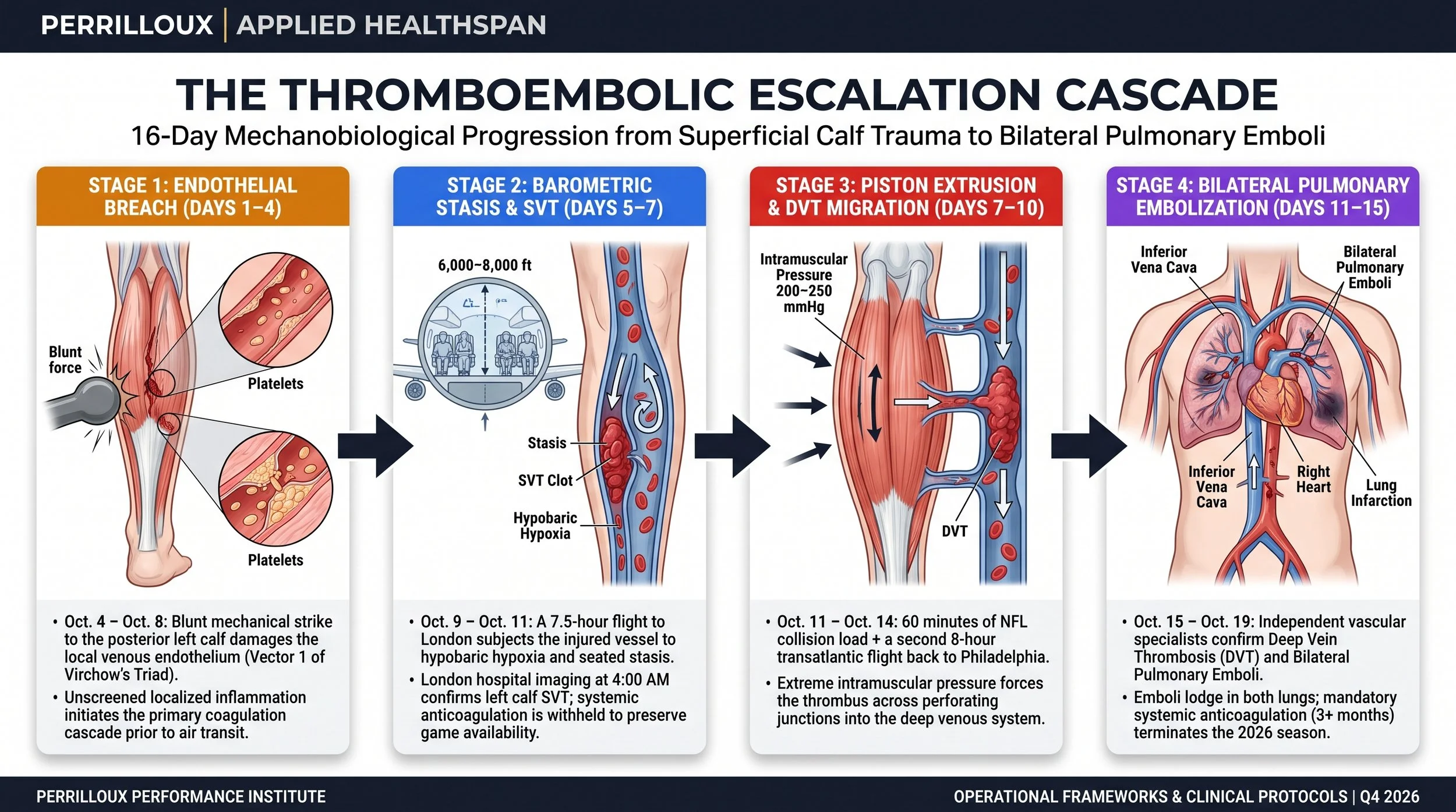
Stage 1: The Endothelial Primer (Days 1–4): When Hurts was cleated in the left calf on October 4, the blunt mechanical shear damaged the delicate inner endothelial lining of the posterior superficial venous network. Exposure of subendothelial collagen and tissue factor immediately initiated localized platelet adhesion and fibrin deposition. Without a diagnostic duplex ultrasound prior to departure on October 8, this subclinical thrombus remained invisible.
Stage 2: Hypobaric Stasis & Circadian Sympathetic Surge (Days 5–7): On October 9, Hurts boarded a 7.5-hour charter flight to London. Commercial and charter aircraft cabins are pressurized to an equivalent altitude of 6,000 to 8,000 feet. This hypobaric hypoxia reduces arterial oxygen tension, triggering endothelial activation, dehydration-induced hemoconcentration, and a documented spike in thrombin generation. Combined with prolonged seated immobilization (kinking the popliteal vein behind the knee), the localized clot propagated into a symptomatic Superficial Vein Thrombosis (SVT)—requiring hospital evaluation in London until 4:00 a.m. on game day. Compounded by acute circadian disruption and sleep deprivation prior to kickoff, systemic catecholamines surged, further increasing platelet reactivity and vascular shear.
Stage 3: The Intramuscular Piston & Clot Migration (Days 7–10): Here lies the central failure of Employer-Captive Medicine. In a sedentary patient, mild walking helps prevent venous pooling. Extrapolating that guideline to clear an un-anticoagulated NFL quarterback for 60 minutes of collision football violates basic hemodynamics. During explosive sprinting and contact, the gastrocnemius-soleus muscle complex acts as a high-pressure biological piston, driving intramuscular compartmental pressures to 200–250 mmHg. Instead of "dissolving" an unanchored superficial thrombus, those violent pressure spikes—immediately followed by a second 8-hour hypobaric flight back to Philadelphia—mechanically squeezed the propagating clot across the perforating junctions directly into the deep venous system. By Wednesday night (October 14), follow-up ultrasound confirmed the inevitable: the clot was moving.
Stage 4: Venous Thromboembolism & Bilateral Pulmonary Capture (Days 11–15): Once a thrombus breaches the deep venous system (DVT) without systemic anticoagulation, it enters a high-velocity, large-caliber conduit leading straight to the heart. Sheared loose by venous return, fragments of the deep clot traveled up the femoral and iliac veins into the Inferior Vena Cava, passed directly through the right atrium and right ventricle, and were pumped into the pulmonary arterial tree—lodging in both lungs as Bilateral Pulmonary Emboli (PE).
Why were no systemic blood-thinning agents (low molecular weight heparin/Direct Oral Anticoagulants) given to the patient in London, at 4:00 a.m., immediately when the SVT was diagnosed? Under professional contact sport guidelines, once an athlete is placed on systemic anti-coagulation therapy, they are automatically disqualified from competition; there is a significant risk that if the athlete experiences any form of collision (internal or intracranial hemorrhage), the athlete could be fatally injured.
To start, the medication meant losing the asset for Sunday’s broadcast window. By withholding anticoagulation and clearing the athlete to play and fly, Franchise-First Triage traded long-term biological sovereignty for four quarters of short-term roster uptime.
Clinical Evidence Annex: Answering the Two Core Diagnostic Questions
To separate public speculation from vascular science, peer-reviewed literature provides clear answers to the two most common clinical questions surrounding this escalation:
1. Were the deep vein clots missed initially, or did a superficial clot migrate?
Three key clinical realities are pointed out by the vascular literature when an apparent superficial vein thrombosis (SVT) appears as a deep vein thrombosis (DVT), along with bilateral pulmonary embolisms in a short time frame:
High rate of concurrent, unrecognized DVT at baseline (25% to 29%): The landmark POST (Prospective Observational Superficial Thrombophlebitis) study (Annals of Internal Medicine, Decousus et al., n=844) and JAMA reviews found that 24.9% of patients who presented with what appeared to be an SVT already had a concurrent DVT at their initial presentation; also 3.9% were already experiencing symptoms from a pulmonary embolism. Athletes with significant muscle mass have deep calf veins (the paired tibial, peroneal, and soleal sinuses) that cannot always be fully visualized on a quick assessment, resulting in false negatives on limited scans for detecting DVTs in approximately 15% to 30% of cases.
CHEST guideline threshold for anticoagulant therapy: There is a direct progression of approximately 10% of isolated SVTs into the deep venous system through either the saphenopopliteal junction or perforating veins. According to CHEST guidelines, any SVT over 5cm in length or that is within 3cm of a deep venous juncture has a thromboembolic risk similar to an existing DVT and therefore needs immediate prophylactic anticoagulant therapy for 45 days.
Diagnostic Trap - "Superficial Femoral Vein": Bundens et al. ("The Superficial Femoral Vein: A Potentially Lethal Misnomer") reported that the primary deep vein of the thigh was previously referred to as the "superficial femoral vein" (SFV). Practitioners who do not understand nomenclature and/or are mistaken about the location near a deep juncture will severely underdiagnose.
2. What Genetic & Hematologic Tests Must Be Done Prior to Returning an Athlete to Play?
The typical return-to-play protocol for an otherwise healthy, 28-year-old athlete who rapidly progresses from a local calf strain to bilateral pulmonary emboli requires a comprehensive Hereditary and Acquired Thrombophilia Panel be identified to determine their lifetime recurrence risk (the clinical factor that forced NBA player Chris Bosh into retirement):
Genetic Mutations: Factor V Leiden mutation (activated protein C resistance); prothrombin G20210a gene mutation (PCR testing via DNA; these tests remain reliable while the patient is on active anticoagulant therapy).
Endogenous Anticoagulant Deficiencies: Protein C, Protein S, and Antithrombin III deficiencies (Functional assays must be conducted once anticoagulation therapy has been stopped, as acute thrombosis and blood thinners will cause inaccurate readings with regard to baseline values.
Structural and Lipid Prothrombotic Factors:
Sickle cell trait (heterozygous HbAS), elevated Lp(a), which interferes with plasminogen activation under conditions of hypoxia.Autoimmune Coagulopathies:
Antiphospholipid syndrome test (Lupus anticoagulant, anticardiolipin antibodies, anti beta-2-glycoprotein I)
The Cross-Coupled Failure Cascade: Perrilloux Performance Architecture Matrix
| Pillar & Subsystem | Clinical Input | Systemic Failure If Siloed |
|---|---|---|
| I. Sports Medicine & Orthopedics Subsystem: Structural Rebar | Osteogenic Loading / TBS Telemetry | High density without fracture resistance; brittle structural failure. |
| II. Recovery & Rehabilitation Subsystem: Active Suspension | P.A.T.H. Protocol / Mechanotransduction | Disorganized scar tissue and metabolic detraining via passive rest—or catastrophic vascular embolization if Stage 1 Triage (S.T.E.P.S.) is bypassed. |
| III. Human Performance & Healthspan Subsystem: Hydraulic Superhighway | ApoB Particle Count / Zone 2 Dilatory Shear | Endothelial collisions, silent arterial plaque, and venous thromboembolism under barometric stasis. |
| IV. Mental Preparation Subsystem: Central Processing (CPU) | Nocturnal Glymphatic Flush / Capillary eNOS | Microvascular constriction, sympathetic catecholamine surges from sleep deprivation, and executive latency. |
| V. Nutrition, Endocrinology & Hormones Subsystem: Just-In-Time Fuel Logistics | Chrono-Nutrition / Lean Mass & Biochemical Defense | Catabolic skeletal loss, dehydration-induced hemoconcentration, and impaired fibrinolytic balance. |
Recovery & Vascular Technology Matrix by Investment Tier
Compression & vascular recovery technologies may not be designed to meet specific clinical standards. Athletic compression stockings manufactured by consumer products companies apply equal pressure to the lower limbs, which can occlude the popliteal space and exacerbate venous pooling. Medical-grade compression garments or dynamic active neuromuscular/pneumatic pumping are required to offer true vascular protection.
(IMPORTANT CLINICAL FIRE WALL: The use of pneumatic compression boots and/or neuromuscular electrical stimulation is limited to preventive measures on clinically normal limbs. Mechanical compression devices or DTP (deep tissue percussion) should never be used on a leg suspected to have an active thrombosis.)
| Investment Tier | Modality & Clinical Standard | Physiological Mechanism & Use Case |
|---|---|---|
| Tier 1: Essential ($50 – $180) Bauerfeind, Sigvaris, Juzo, Medi, CEP | Medical-Grade Graduated Compression Stockings (RAL / FDA Class I & II) | The Graduated Pressure Standard: Look for 20–30 mmHg (Class II medical grade) or 15–20 mmHg for general travel. RAL-certified stockings exert 100% pressure at the ankle and taper to 50–70% at the calf, preventing tourniquet effects behind the knee. |
| Tier 2: Advanced ($250 – $450) Firefly Recovery (OnPulse), gekō™ Device | Wearable Neuromuscular Peroneal Nerve Stimulators (FDA-Cleared DVT Prophylaxis) | Active Venous Velocity Without Load: A disposable bioelectronic strip applied over the common peroneal nerve below the knee. Delivers a gentle electrical impulse that triggers a micro-twitch of the calf muscle pump, increasing microcirculatory and deep venous blood flow by up to 60%. |
| Tier 3: Pro / Clinical ($800 – $1,500) Normatec Elite, Rapid Reboot, Therabody | Dynamic Intermittent Pneumatic Compression (IPC) | Sequential Peristaltic Flushing: Multi-chamber pneumatic sleeves that inflate distally-to-proximally (20–100 mmHg) to clear interstitial lymphatic exudate and venous pooling post-flight or post-training. (Contraindicated if active DVT/SVT is suspected). |
| Tier 4: Institutional ($3,500 – $25,000+) Butterfly iQ3, GE Vscan Air CL, Airofit / Moxy | Point-of-Care Duplex Ultrasound & Vascular Telemetry | Sovereign Diagnostic Verification: Enables a retained team or executive physician to perform immediate, high-resolution B-mode and Color Doppler compression ultrasonography prior to boarding an aircraft. |
The Clinical & Economic Hazard: A Healthcare Management Audit
From a healthcare administration and risk-management perspective, Jalen Hurts' vascular crisis illustrates how extreme misaligned incentives are found in Health Economics under the term "Principal-Agent Problem."
Asymmetrical Liability & Moral Hazard: The franchise derives all short-term revenue and competitive utility from using its star asset on Sundays, whereas the Athlete bears 100% of the catastrophic biological tail risk.
The Cost of Diagnostic Omission vs. Acute Solution: A Low-Cost, zero-radiation diagnostic filter used at the point of care for venous duplex ultrasonography ($300-$800). Bypassing definitive vascular clearance prior to hypobaric air transit converts a manageable localized thrombosis into an inpatient pulmonary embolism crisis—multiplying acute-care costs and sidelining a vital asset.
Failure of Independent Self-Audit Governance: When the NFL's internal audit finds that a protocol that resulted in bilateral pulmonary emboli was "handled appropriately," it clearly exemplifies Regulatory Capture. Therefore, clinical governance must be audited by an independent body with no reporting lines to the commercial front office.
The Perrilloux Protocol: Proactive & Reactive Vascular Defense
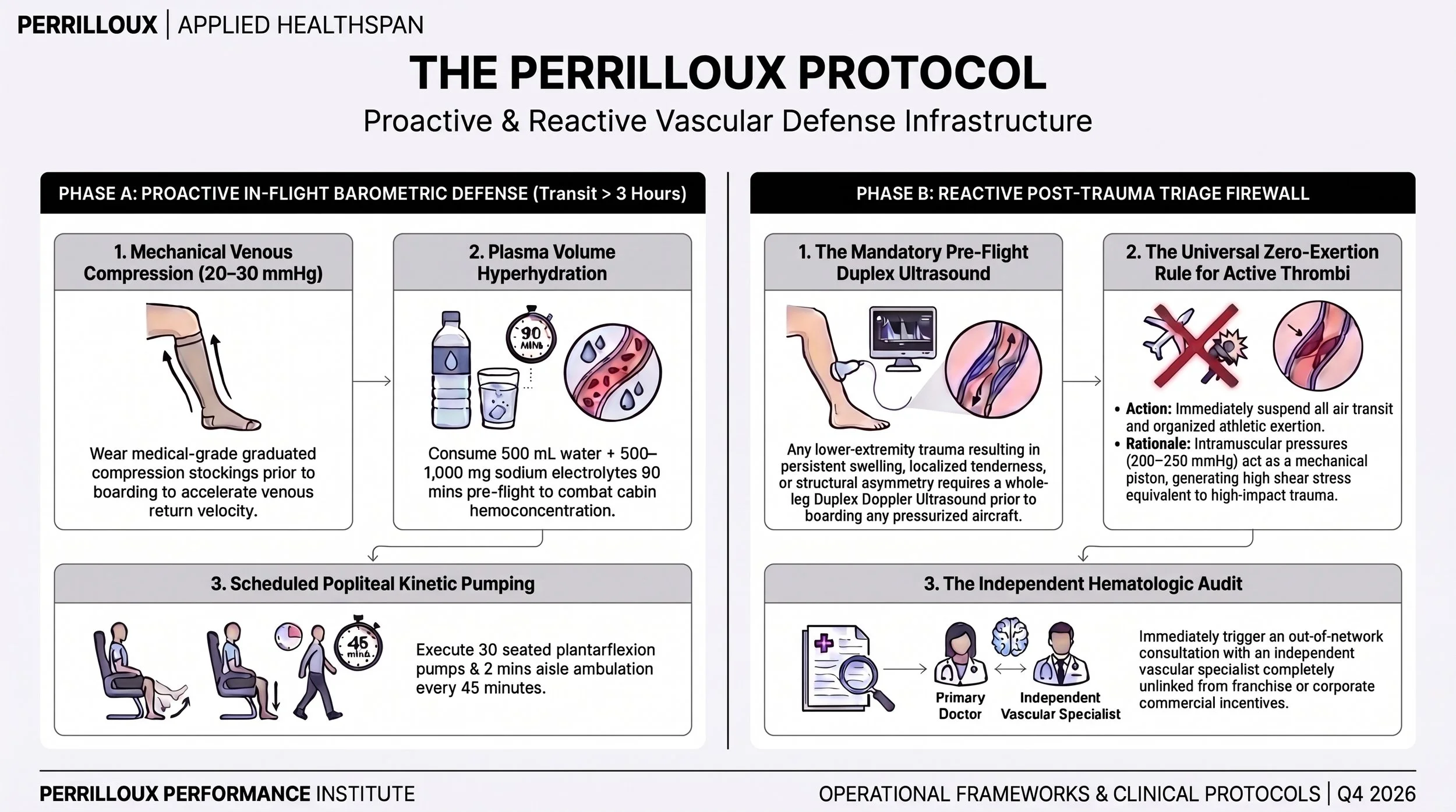
PHASE A: PROACTIVE IN-FLIGHT BAROMETRIC DEFENSE (Transit > 3 Hours)
Mechanical Venous Compression (20–30 mmHg): Wear medical-grade graduated compression stockings prior to boarding to accelerate venous return velocity.
Plasma Volume Hyper-Hydration: Consume 500 mL of water with 500–1,000 mg sodium electrolytes 90 minutes pre-flight to combat cabin hemoconcentration.
Scheduled Popliteal Kinetic Pumping: Execute 30 seated plantarflexion pumps and 2 minutes of aisle ambulation every 45 minutes.
PHASE B: REACTIVE POST-TRAUMA TRIAGE FIREWALL
The Mandatory Pre-Flight Duplex Ultrasound: Any lower-extremity trauma resulting in persistent swelling, localized tenderness, or structural asymmetry requires a whole-leg Duplex Doppler Ultrasound prior to boarding any pressurized aircraft.
The Universal Zero-Exertion Rule for Active Thrombi: If an ultrasound detects any venous thrombus (including superficial vein thrombosis/SVT), all pressurized air transit and all forms of organized athletic exertion (collision sports, endurance training, and heavy resistance work alike) are immediately suspended.
Due to internal intramuscular hydrostatic pressures (200–250 mmHg) acting as a mechanical piston, repetitive cyclical training poses a shear risk identical to that of high-impact trauma.
The Independent Hematologic Audit: Immediately trigger an out-of-network consultation with an independent vascular specialist completely unlinked from franchise or corporate commercial incentives.
APPENDIX: THE CLINICAL EVIDENCE BASE
This framework translates peer-reviewed sports medicine, clinical data, and mechanobiology into operational practice.
Clinical Data: Dr. Hélène Decousus's landmark prospective multi-center cohort study demonstrated that 24.9% of patients presenting with an apparent isolated Superficial Vein Thrombosis (SVT) already harbor a concomitant deep venous propagation at their initial evaluation. Her data support the conclusion that un-anticoagulated proximal superficial clots exhibit a high ~10% absolute rate of migrating directly into the deep venous system via the saphenofemoral or saphenopopliteal junctions. This underscores the risk of relying on standard institutional triage that dismisses superficial trauma as a benign event.
Clinical Data: The international executive scientific committee overseeing the WRIGHT project established that long-haul travel lasting longer than 4 hours doubles to quadruples the baseline absolute risk of venous thromboembolism (VTE). The data prove that combining localized mechanical soft-tissue trauma with prolonged seated venous stasis and commercial cabin hypobaric hypoxia (~6,000–8,000 ft) drives accelerated systemic thrombin generation while actively blunting endogenous fibrinolytic pathways. Bypassing definitive vascular clearance prior to pressurized air transit converts a manageable localized injury into an acute, life-threatening pulmonary crisis.
Clinical Data: Breakthrough chronobiology protocols managed by Dr. Frank Scheer and Dr. Steven Shea proved that acute sleep restriction and circadian disruption induce severe prothrombotic blood metrics, spiking sympathetic catecholamines, arterial blood pressure, and Plasminogen Activator Inhibitor-1 (PAI-1). Their data demonstrate that elevated PAI-1 serves as a direct physiological brake that suppresses the body's natural clot dissolution mechanisms. Subjecting an athlete to extreme sleep curtailment immediately prior to intense physical loading cripples their natural defense against vascular propagation.
Clinical Data: Human muscle pump mechanics modeled by lead investigators Dr. Roman A. Tauraginskii and Dr. Fedor Lurie confirmed that explosive lower-extremity athletic loading and repetitive, high-intensity concentric/eccentric muscle contractions generate intense localized intramuscular fluid pressures between 200–250 mmHg. This massive compartmental compression exerts a powerful hydraulic force that acts as a physical piston, mechanically shearing un-anticoagulated deep-tissue thrombi away from the venous walls and driving them directly into pulmonary arterial circulation.
Clinical Data: The definitive clinical evaluation protocols established by Dr. Daniele Pastori and Dr. Pasquale Pignatelli prove that heritable hypercoagulable substrates dramatically amplify baseline risk profiles. Their research confirms that managing an anomalous clotting event requires an exhaustive genetic panel mapping Factor V Leiden, Prothrombin G20210A mutations, Protein C/S/Antithrombin regulatory deficiencies, and baseline Lipoprotein(a) elevation metrics. Without independent self-audit governance and rigorous screening, an organization remains completely blind to the underlying genetic variables that dictate an athlete's survival under severe environmental and kinetic stress.
The Bottom Line for High-Performing Professionals & Elite Athletes
Whether an NFL quarterback is being stepped on by another player or a CEO is logging 150,000 air miles annually, the biological rules that apply are the same.
Never Confuse Institutional Convenience with Clinical Safety: Always have an independent clinical advocate with no obligations other than protecting you biologically.
Treat Lower-Extremity Trauma + Air Travel as a High-Alert Vascular Event: Demand a diagnostic duplex ultrasound prior to boarding the airplane.
Engineer Your Own Barometric Firewall: Use medical-grade compression, structured hydration, and popliteal muscle pumps.
Govern All Five Pillars Simultaneously: A failure of one pillar of care in vascular triage or sleep architecture will collapse the entire system.
The team doctor protects the logo. The corporate clinic protects the balance sheet. You must take complete ownership of your healthcare and build a care team that answers only to you.
PERRILLOUX PERFORMANCE: CLINICAL ARCHITECTURE
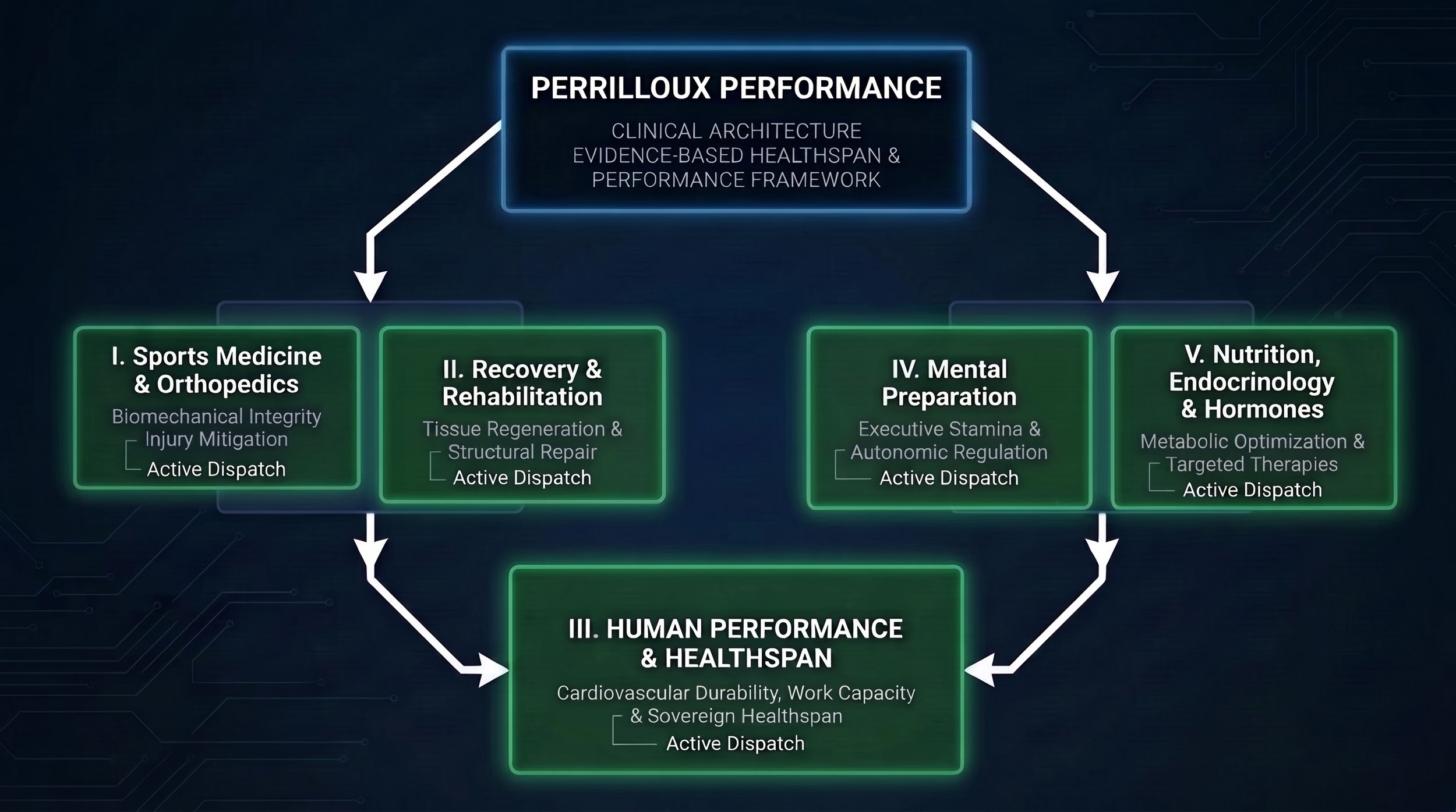
This dispatch represents an active operational module within the Five Core Pillars of the Perrilloux Performance clinical architecture.
[X] I. Sports Medicine & Orthopedics (Biomechanical integrity & injury mitigation)
[X ] II. Recovery & Rehabilitation (Tissue regeneration & structural repair)
[X] III. Human Performance & Healthspan (Cardiovascular durability & bioenergetics)
[X] IV. Mental Preparation (Executive cognitive stamina & autonomic regulation)
[X] V. Nutrition, Endocrinology & Hormones (Metabolic optimization & targeted therapies)
Perrilloux: Applied Healthspan delivers weekly clinical analysis and health systems intelligence.